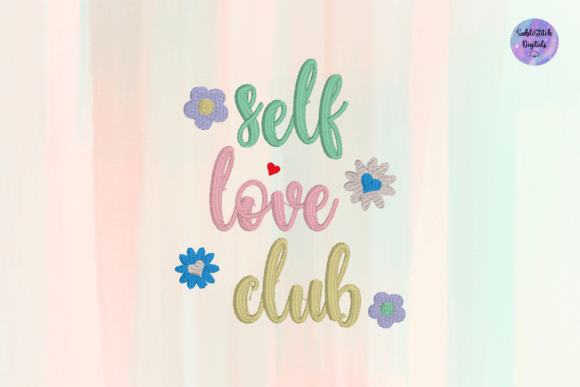
Self Love Club Embroidery Review
A First Impression: Soft Strength, Quiet Confidence
Opening the Self Love Club embroidery file on my design software, I felt immediate alignment—not just with the sentiment, but with its visual execution. This isn’t a shout-it-from-the-rooftop inspirational design. It’s gentle, intentional, and thoughtfully composed. The lettering has subtle rounded edges and delicate flourishes—neither overly scripty nor rigidly blocky. There’s breathing room between elements, and the overall stitch density feels balanced: rich enough to read clearly on apparel, but not so heavy that it overwhelms lightweight knits or adds unnecessary bulk. It leans feminine without being saccharine, modern without chasing trends, and warm without leaning into cliché. For boutique apparel, that quiet confidence is gold.
Sweatshirt & Hoodie Performance: Where It Truly Shines
I tested Self Love Club on three sweatshirt variations: a heavyweight charcoal French terry hoodie, a midweight oatmeal cotton-blend crewneck, and a soft heather grey fleece-lined pullover. On all three, the design held beautifully at standard chest placement—centered just below the collarbone. Its moderate width (I estimated ~3.5–4 inches wide based on preview) avoids crowding the shoulder seam while still commanding presence. On oversized hoodies, I shifted it slightly lower for proportional balance—and it worked seamlessly. As a sleeve accent? Surprisingly effective on the upper bicep of a relaxed-fit hoodie, especially when paired with tonal thread. For back designs, I resized it to ~5.5 inches and added minimal topstitching framing—it elevated a simple black sweatshirt into a cohesive lifestyle piece.
What Works—and What Needs Careful Handling
- Dark garments: Excellent contrast with light or medium-toned threads (ecru, blush, soft sage). Avoid very pale pastels on black—test first.
- Stretchy fabric: Use a medium-weight cutaway stabilizer underneath and a light tear-away on top. The curves in the lettering hold well *if* stabilized properly—no puckering on ribbed cuffs or side seams.
- Fleece & textured knits: Slightly higher stitch density means you’ll want to avoid ultra-thin fleece. Stick with medium-to-heavy fleece or brushed cotton for clean results.
- Curved surfaces (like shoulders or hems): Hoop carefully—the design’s symmetry helps, but always do a test run on scrap from the same garment batch.
- Tiny details: No micro-lettering here—no risk of lost definition. Even at 3-inch width, every curve remains legible.
Beyond Sweatshirts: Versatility That Builds Brand Cohesion
Self Love Club isn’t limited to apparel—it strengthens entire product ecosystems. On denim jackets, it reads as quietly cool and grounded—especially in matte black or navy thread. On canvas tote bags, it anchors minimalist branding without shouting. For seasonal collections, I stitched it onto cream-colored knit beanie bands and oatmeal flannel pillow covers; each time, it reinforced a consistent, values-driven aesthetic. As part of a boutique brand’s visual language, Self Love Club becomes more than decoration—it signals intentionality, care, and emotional resonance. Buyers notice that. Etsy sellers report higher engagement on listings where this design appears in natural-lit lifestyle photos—think a model sipping tea in a hoodie, or a flat lay with a tote, journal, and mug.
Commercial Use & Professional Presentation
For small shops and handmade product creators, Self Love Club supports credibility. Its clean execution says “designed with purpose,” not “downloaded and rushed.” When used consistently across t-shirts, hoodies, and totes, it builds instant recognition—no logo required. Customers begin associating that graceful typography with your brand’s voice. That consistency also streamlines production: once you dial in stabilizer choice and thread palette (I recommend 2–3 core colors max), scaling across SKUs becomes efficient. And because it’s an Inspirational machine embroidery design, it pairs effortlessly with complementary motifs—think tiny hearts, abstract line art, or botanical accents—without visual competition.
Designer Notes You Can’t Skip
Before stitching your first Self Love Club piece for sale, do these six things:
- Test on scrap fabric pulled directly from your garment batch—not generic swatches.
- Confirm stabilizer match: Cutaway for stretchy knits, tear-away for stable wovens like denim or canvas.
- Review thread color contrast under both daylight and indoor lighting—some ecru tones disappear on cream fabrics.
- Check hoop size compatibility with your machine and intended placement—don’t assume it fits your smallest hoop.
- Inspect stitch density visually in your embroidery software—if it looks overly dense on screen, reduce scale slightly before hooping.
- Verify licensing terms on the Creative Fabrica product page—especially if selling finished apparel commercially.
Final Thought: A Design That Earns Its Place
Self Love Club doesn’t just say something—it carries weight. Not in heaviness, but in resonance. For embroidery designers building boutique apparel lines, it’s a rare find: a digital embroidery file that balances emotional appeal with technical reliability. It works on sweatshirt embroidery, hoodie design, t-shirt embroidery, and tote bag design—not because it’s generic, but because it’s intentionally restrained. It invites connection without demanding attention. And in a market saturated with loud graphics and fleeting trends, that kind of quiet strength? That’s what turns a small shop product into a meaningful keepsake—and a handmade product into a story people want to wear.